
Cannery Row by John Steinbeck is a classic American slice-of-life novel that follows a group of communal, yet unmistakably distinct characters navigating their self-contained world within the neighborhood surrounding Cannery Row. Cannery Row itself is simply a street with a sardine cannery. Through the noise and pollution of the cannery, we focus on Lee Chong’s general store, Mrs. Dora’s whore house, Doc’s Western Biological Laboratory, and Mack’s abandoned Palace Flophouse. Along with other minor yet meaningful characters, this cohort goes about their days in a mid-Depression world where companionship and loneliness go hand in hand. Despite the rhythmic, periodic nature of these two competing tides, neither distinguishes itself as the superior. Companionship carries a simultaneous sense of fulfillment and chaos while loneliness, sadness and peace.
As strongly hinted in the introduction to this book, witnessing the lives of the residents of Cannery Row is comparable to quietly sitting and observing a tide pool and its organisms. The latter is an activity I frequently do. This comparison is beyond mere speculation, as Steinbeck resided in Monterey, the real city that Cannery Row takes place in. There he befriended one Ed Ricketts, who is the dedicatee of Cannery Row and the inspiration for Doc, arguably the story’s central character. It just so happens that I have taken a class on marine zoology at Stanford deeply rooted in the work of Ricketts and his legacy text: Between Pacific Tides. I have also been a recurring visitor of Monterey and its many amazing tide pools since I could first influence the location of my family road trips. I have spent countless hours wading, squinting, and collecting, in the exact tide pools Doc collects from. It goes without saying that every visit to Monterey also leads to a concomitant stroll down the real Cannery Row, which was so named after the fact in honor of Steinbeck’s work. Due to my particular familiarity with the real people and setting behind this work of fiction, I feel a special intimacy with Cannery Row.
There is no tangible central conflict in this story. No bombs and gunshots. No torrent waves or arid dry spells. A tide pool ecosystem on a day of mild surf can appear still for hours on end. Yet, a symphony of inter-species dynamics is silently at play. Cannery Row is no different. As would the organisms in a tide pool, the characters on Cannery Row survive not in-spite of, but because of their complex relationships. As in a tide pool ecosystem, the omnipresence of death in this story is treated with an upsetting yet understandable level of indifference. Despite the façade of stasis, the Row and its residents fight the ceaseless human battle for survival.
For this book review, I compare the characters of Cannery Row with their closest tide pool counterpart.
Doc: Doc is a solitary, perceptive, enigmatic, and emotionally lonely character. Although he is no stranger to company, whether it be a date or a party, he manages to stay perpetually siloed by only temporarily taking the social form necessitated by his company. He is liked by all, not loved by any. His true calling is his science, and the exploration for the unknown. The same hours others would spend relaxing, Doc answers this call as the tides draw him towards their field. As sharp as they come, he exhausts his cleverness in the lab and dedicates none towards the finessing and exploiting of his peers.
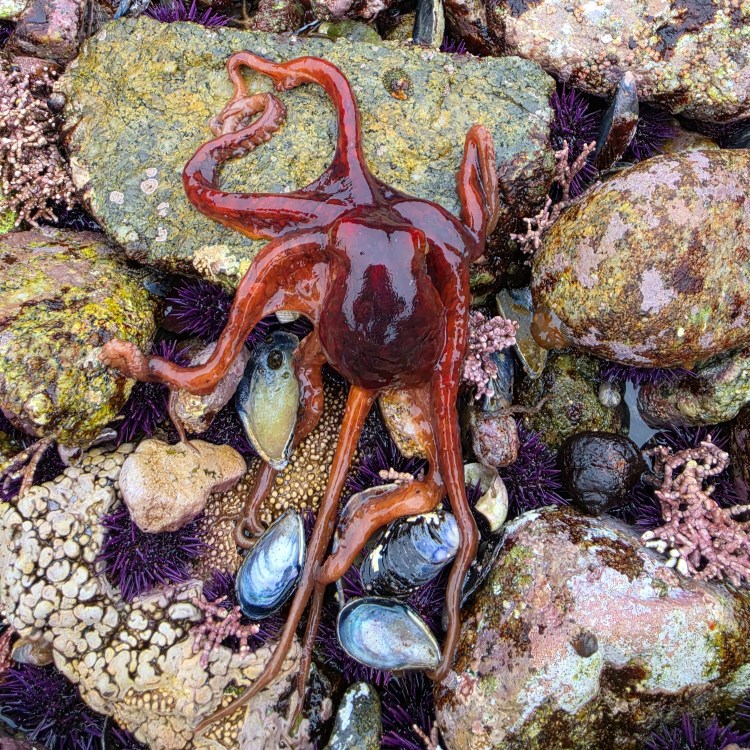
The octopus, equally enigmatic, is the only suitable comparison for Doc. The octopus is famous for its solitude and astonishing intelligence relative to other tide pool organisms. It is able to blend into many environments without establishing any as “home”. Given its intelligence and dexterity, the octopus does not lack the ability, but rather the will, to take advantage of its fellow pool mates. Instead, it lies calm and observant, takes only what it needs, and relinquishes control of the pool to the gravity of the moon. The octopus is also one of the only creatures that displays significant curiosity, simultaneously groping and comprehending foreign objects or the hand of a beachcomber after just a fleeting period of prudence.
Lee Chong: The backbone of sustenance for Cannery Row, Lee Chong single-handedly feeds, and in some cases even houses, the residents of the Row. He is reliable; always present behind his cashier stand in his shop. He is also guarded and cautious; keeping a keen eye on shoplifters and tacitly executing his transactions for economic optimality.
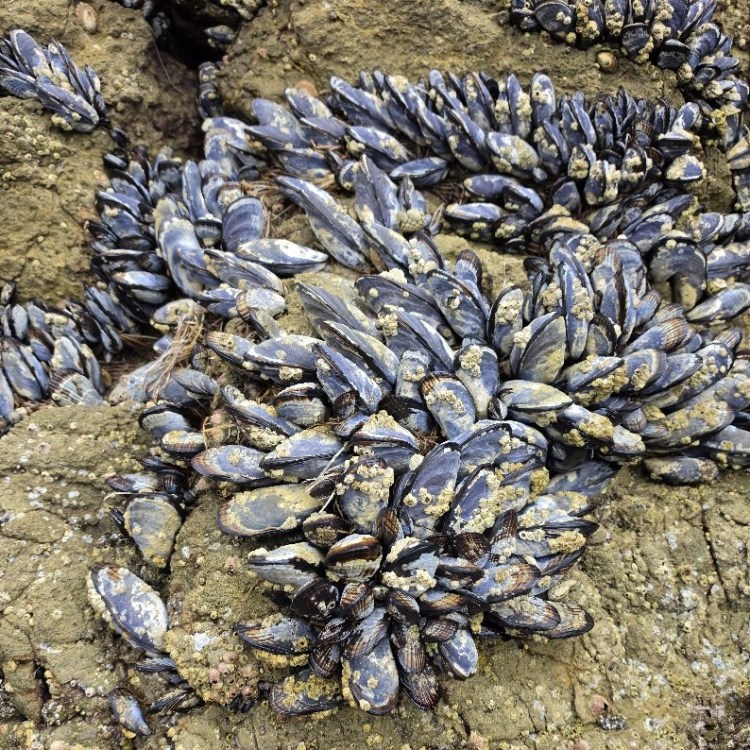
Even the infrequent beachgoer is sure to have come across rocks festering with mussels who sprawl across the surface like a scab. Once rooted to a rock with their Byssal Threads, mussels stay put. In their abundance, they serve as the primary food source for many creatures higher up on the hierarchy of appetites. They are, however, no easy picking. The avaricious predator pays for its meal in time and energy bypassing the mussel’s hard shell and speedy shut trigger.
Mrs. Dora: An insistent feminine presence on the Row, Mrs. Dora runs the Bear Flag whore house with an admirable level of professionalism and philanthropy. Following her head of fiery orange hair, her girls collectively serve as a maternal figure to Cannery Row. In dire situations, Mrs. Dora and her girls are more than ready to offer a meal, nursing, or simply platonic companionship. Yet ironically, the Bear Flag itself is the antithesis of this generosity, attracting vagrant troublemakers seeking quick satisfaction along with bruises and guilt.
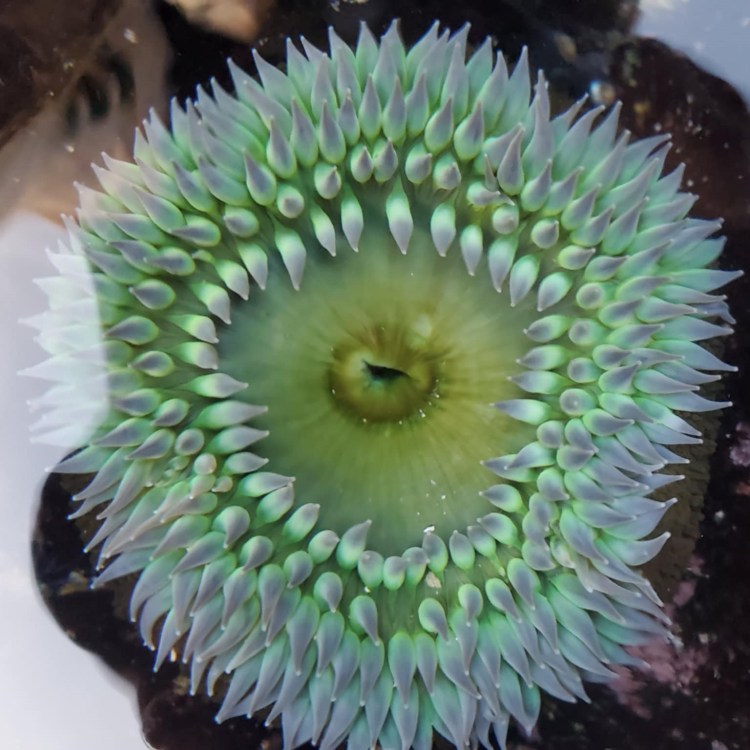
As a wandering traveler’s eyes would certainly be first drawn by Mrs. Dora and her girls at the Bear Flag, a stray beachgoer is likely to first set eyes upon the brilliant hues of the gigantic anemones swaying to the ocean currents. These anemones are a symbol of pool vitality, indicating a steady stream of fresh seawater which allows ever-important algae to grow. Yet, the ignorant crab wandering too close to the anemone’s mesmerism may find its temptation to be its demise at the hands of hundreds of rapidly-enclosing stinging tentacles.
Mack (and his boys): Mack’s posse of Eddie, Hughie, Hazel, and himself are the unintentional philosophers of Cannery Row. They spend their days drinking idly, scavenging for a meal (or a pint), or busying themselves with minutia such as helping Doc collect 700 frogs. They spend their nights in the Palace Flophouse: a sorry excuse for a home by layman’s standards. Those unfamiliar with the group may erroneously assume them to be ill-intentioned, yet Mack and his group are Taoism incarnate in their harmless, yielding attitude towards problems that most would find distressing. Their survival hinges on their togetherness. Individually, they would certainly perish as they aimlessly wander through oblivion.
The creature begging parallels with Mack and his boys is the hermit crab. Found by the droves and out in the open in any pool, these small crustaceans live by the saying “one crab’s trash is another crab’s treasure”; exclusively inhabiting the discarded homes of other animals. As their namesake suggests, they spend most of their time just existing, not actively hunting for anything. However, upon smelling even the faintest scent of remains, they are quick to the pickings. Hermit crabs are known to aggregate for protection, and even shell swapping. The isolated hermit crab is a doomed hermit crab.
Gay: If not for the fact that Gay has a wife and a permanent home, he would fit in swimmingly with Mack and the boys. It is exactly these obligations that require him to return home on occasion and leave the inconsequential, carefree lifestyle behind. Gay is shown to be easily the handiest of the group of men, having a “silver thumb” for all that whir, clank, and spin.
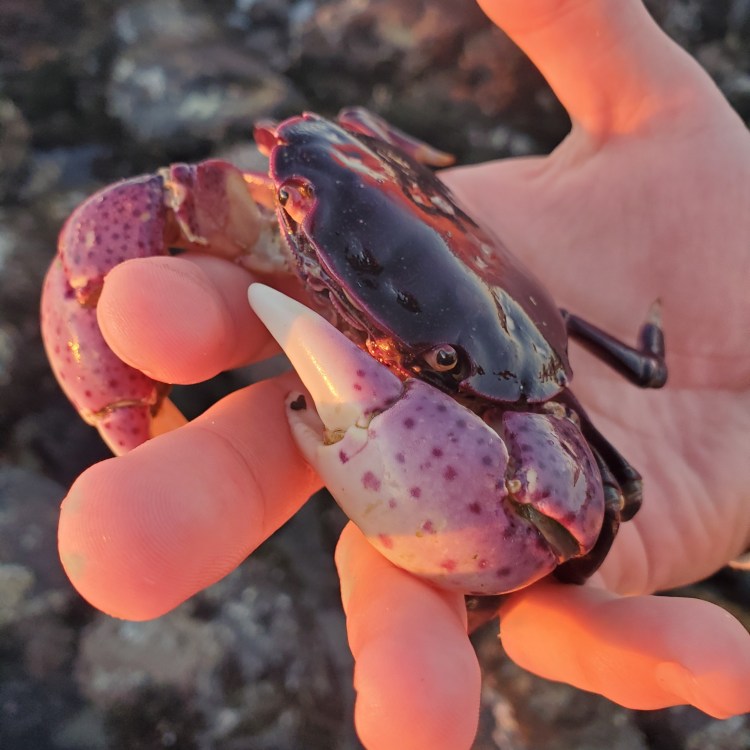
The true crab embodies Gay well. Clearly similar to the hermit crab in evolutionary foundations, the crab differs in that it remains singular and solitary. The crab is also bound in commitment to the shell on its carapace, and does not have the luxury of frequent real-estate shopping. It is allowed to shed once in a while, but only in an effort to strengthen what is ultimately an extension of itself. Needless to say, the crab also easily bests the hermit crab in craftsmanship.
Frankie: Frankie is the most tragic character in Cannery Row and stirred the strongest emotional response from me. He is a mentally disabled little boy who suffers not the worst from his condition, but its collateral social isolation. Doc is the only person who shows him any form of compassion, but is ultimately helpless to save Frankie from his own manufactured shame. Frankie is often found sulking in a bin of wood shavings after his signature social faux-pas. Innocent and curious at heart, Frankie is rejected in a system simply not designed for him.

Frankly, Frankie is best represented by all the former amazing species of the world who have since gone extinct. To avoid this lazy comparison, I have chosen the extant flatworm. Easily one of the most primitive tide pool inhabitants (it lacks even a circulatory system, and is essentially one extended stomach), the flatworm is a delicate, bizarre, and beautiful tide pool creature that must unfortunately limit its domain to the dark and claustrophobic undersides of large rocks in order to avoid predators as a slow and defenseless target. Tragically, the initial human reaction to the discovery of a flatworm is almost invariably repulsion, even if only for a second.
Henri: Henri is the cursed creative whose new ambitions outpace his rate of completion. He is a painter by trade, known to experiment with a diverse palette and medium. Despite his profession, he is most known on Cannery Row for being the constructor of an eternally unfinished boat on which he resides and takes up many short-termed lovers. This boat, like his many relationships, remains incomplete because of Henri’s anxiety about the end-result of having a boat: that he must sail.

Sea slugs, particularly those in Monterey, come in some of the most beautiful colors and planforms in the intertidal, from scarlet red to lemon yellow to rich violets. These slugs, however, are more spectacle than substance. There is little biological utility that comes out of their coloration and patterning, as most of them are not poisonous (the typical implication of startling colors). As with land slugs, sea slugs are slow and rarely venture beyond their local pool.
The Chinaman: This final character is admittedly a character I needed some assistance interpreting. His deeply mysterious figure is hardly featured throughout Cannery Row; only mentioned in passing to “flop flop flop his way to and from the coast” at dawn and dusk without fail. His single short chapter of focus is hallucinogenic and supernatural in an otherwise realistic story. He is mentioned to have a lonely, infinite expanse of land behind his eyes when peered into. This character symbolizes that which is unknown in a vast world/universe.
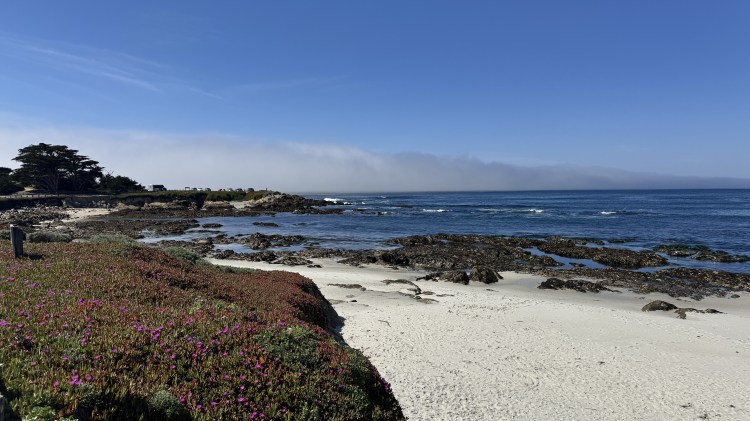
Undoubtedly, the Chinaman represents the tide itself. Coming and going in an unwavering cadence and indifferent to the life in the pools, the tide breathes life into the ecosystem. The tide pool creature would be hopeless in any attempt to understand the complex sun-moon gravitational cycles that cause the tides. It is fascinating to imagine a stray hermit crab spontaneously pondering the question of why the tides exist, only to be met with the same level of existential paralysis as when we ask ourselves “why does anything exist?”. For both our sanity and spirit, this question may be best left unanswered.

