
Mechatronics Design
I’ll keep this post short and sweet. Most of my work pertaining to this class is best represented by my Eggspresso capstone project. The class itself is typically seen as the class that gives students the opportunity to build whatever they want. That being said, there was still light curriculum sprinkled in throughout the semester.
Most of our introductory curriculum revolved around getting a microcontroller to work and talk to basic devices such as motors, speakers, and buttons, nothing I didn’t already know how to do. I would pick up on something new here and there such as what it means to “debounce” a button or what a “bang-bang” controller was. Nonetheless, these all just ended up being fancy names for simple concepts that left me entirely uninterested. Afterwards, we covered the basics of motor selection. Torque-speed curves, stall torques, power ratings and what not. Once again, *yawn. The last module of the course was where I learned something new: gears.
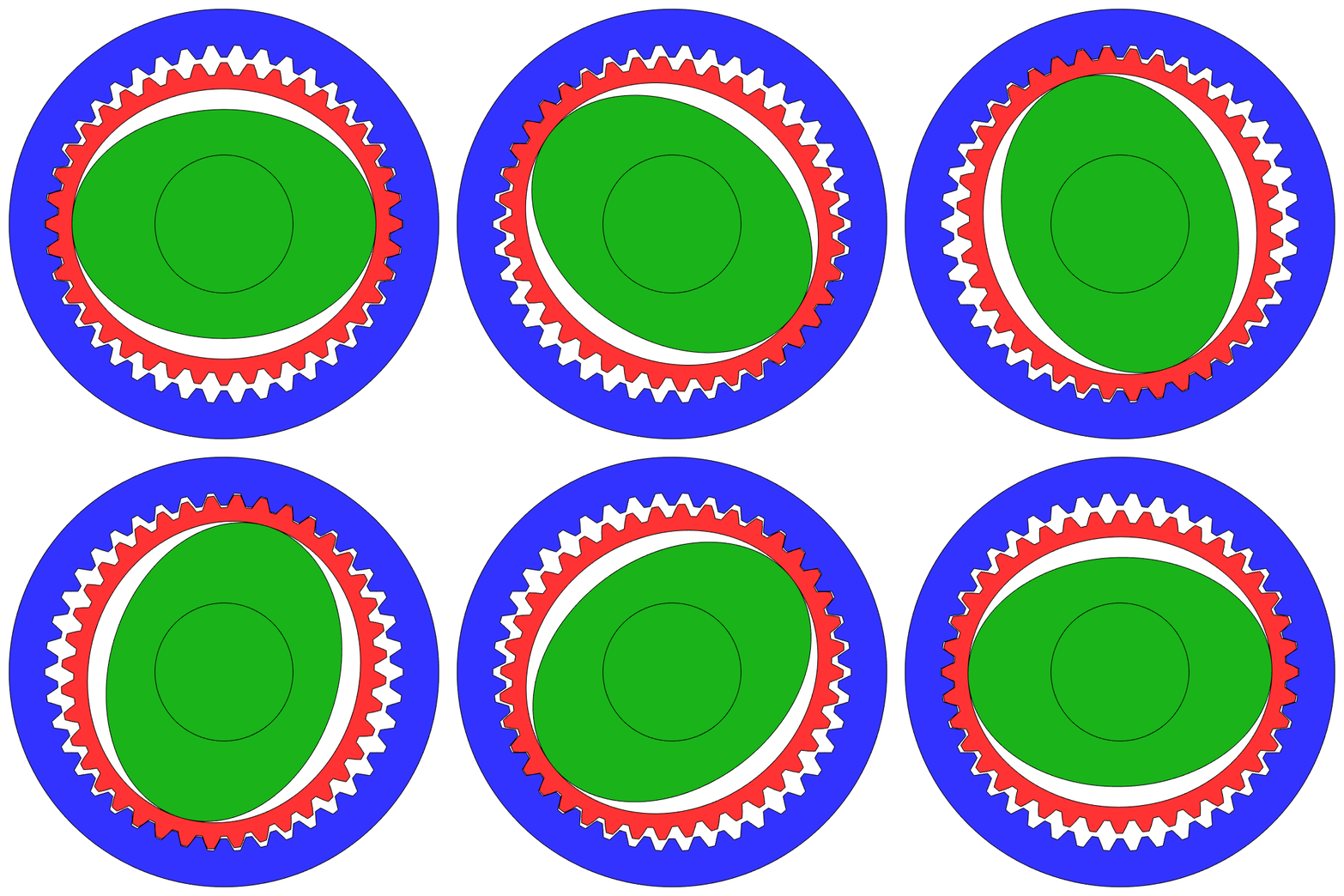
It’s not like I didn’t know what gears were and how they worked before the course. I’d pack up and leave engineering if that were the case. However, this course opened my eyes to certain types of gears that I never knew existed. The most notable of these new gear systems I discovered was the harmonic drive. I had heard the name of this system thrown around here and there, and I always just assumed that it was either a gear train designed to take cyclic input or a lit session of carpool karaoke. Turns out the former was closer.
Food for Thought
On a harmonic drive, the circular spline (blue) has 100 teeth and the flex spline (red) has 98 teeth. What is the reduction ratio of the system? Does the wave generator (green) spin in the same or opposite direction as the flex spline?
 seanlin.dev