
Mousetrap Vehicle is, without question, my favorite Science Olympiad engineering event. The event has endless room for creativity and is the most open-ended of the Science Olympiad engineering events. As well, it does not require the hours upon hours of boring and repetitive work that building a wooden structure requires. Perfecting my vehicle became my number one priority during my senior Science Olympiad season. In fact, as others were too busy not being busy (due to senioritis), I was spending an hour after school every day driving my physics teacher nuts as he constantly dodged the rat-like contraption zooming around his classroom.
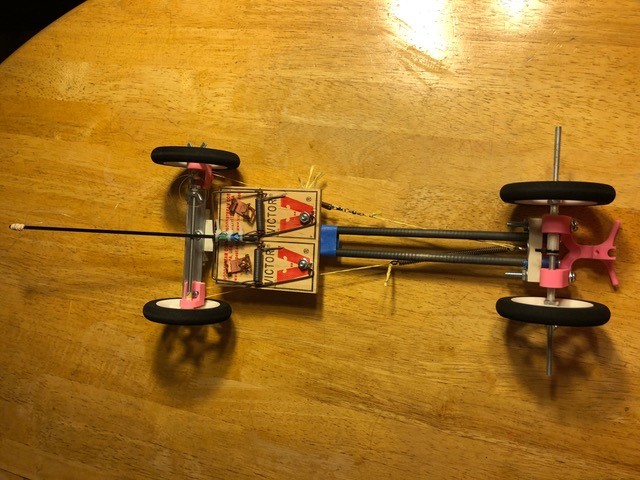
Now, I know what you may be thinking: mousetrap vehicles are such a typical physics project, even I made one in high school. This is where I need to step in and explain the difference, out of respect for the countless hours former me spent engineering and calibrating a car that I assure you is not as crude as the CD-wheeled monstrosities that you saw in your physics class. Firstly, the objective of my car was not only to get it moving, but to have it move fast and stop at accurate intervals. You may notice that there is a vertical rod at the front of my vehicle which seems operationally unnecessary. You are correct, however for competition purposes this is the “reference point” on the vehicle. The track was set up as a straight line with 0 m as the starting point, 12 m as the cup target and a single additional final target. The objective for the car was to push an upside down paper cup as close to the 12 m point as possible (if the cup covered the cup target point, that would be considered perfect). The car was then to switch to reverse and get as close the the end point as possible. The end point was placed anywhere between 11 and 9 m along the straightaway and offset 50 cm perpendicularly to the right of the track. From the moment the mousetrap is triggered/the vehicle begins moving to the moment the vehicle comes to a full stop is the recorded runtime. Teams were placed based on accuracy of both the cup target point and the final target as well as their speed.

Total Score = Runtime (seconds) + Distance between cup and cup target (cm) + distance between vehicle and final target (cm)
*Lowest score wins*
The Basics:

There are a couple fundamental tasks that all vehicles should be able to accomplish including moving, reversing, and stopping. First of all, the movement of the mousetrap vehicle is accomplished by simply attaching a string to tip of the mousetrap and wrapping said string around the back axel of the vehicle. In order to extend the distance that the vehicle is able to travel (12 m is no laughing matter), the length of string wrapped around the back axel must be lengthened. As such, I decided to extend the arm of the mousetrap in order to make room for more string. Changing direction proved not to be as tricky as I originally thought. In fact, to change direction, all I did was attach a zip-tie to the back axel of the car. Using the knob of the zip-tie, I would wrap the string around it and change my winding direction. During the run, there would be a small click, and the vehicle would begin reversing. The task of stopping actually ended up being the trickiest. For traditional braking, I used a wingnut-bolt system with the bolt acting as the axel to my front wheels. This is a fairly well-known braking system for hobby cars that can accurately stop a car after X number of wheel turns. However, in this specific case, the traditional wingnut-bolt would fail as the car needed to stop somewhere in the middle of the return trip. Thus, the obstacle that stops the wingnut must be bypassed on the way to the 12 m cup drop-off and stopped ONLY on the way back. This called for a one-way obstacle in the path of the wingnut that could reliably stop the wingnut ONLY on the way back. A simple add-on to the traditional wingnut-bolt braking system sufficed.
Target Accuracy:
From prior experience, I knew that getting the cup to the perfect 12 m spot was a MUST if I was to remain competitive with some of the top performers. Getting the cup to the 12 m mark exactly was a simple matter of calibration. After trial and error, I determined the perfect number of string wraps around the back axel to achieve exactly 12 m of travel distance before the string unwound around the zip tie and began moving the vehicle in the opposite direction. In fact, I uniformly spaced out a series of angular stopping points on my back wheels and color coded them to remember which point to set the vehicle to at the start position to achieve a perfect 12 m cup push.
Achieving accuracy on with the final target point was more difficult and was perhaps the most difficult aspect of the entire event. Hypothetically, if the final target point for the vehicle was placed along the straight line that spanned the starting and cup target points, the vehicle would need only to go straight and back up straight as well. However, due to the 50 cm offset towards the right, the vehicle had to move in a curve! In fact, this curvature needed to be adjustable as well! A final target point offset by 50 cm from the 11 m mark required a larger radius of curvature than one offset from the 9 m mark.
To accomplish the task of adjustable path curvature, I needed to make the front wheels of the vehicles rotatable. In addition, I attached two industrial grade chords to the ends of the front axel and looped the other end around a bolt towards the middle of the car. Along one chord, I inserted a spring and along the other, I inserted a length-adjusting screw. The matter of adjusting radius of curvature came down to toggling the length-adjusting screw. Interestingly enough, the changes in radius of curvature were so small between different final target points that I became lazy and just found a fixed radius that worked well for all points along the 9 m – 11 m range and rarely ever adjusted thereafter. Regardless, the adjustability factor still came in useful whenever I had to recalibrate the vehicle repeated use or sometimes even temperature and humidity differences!

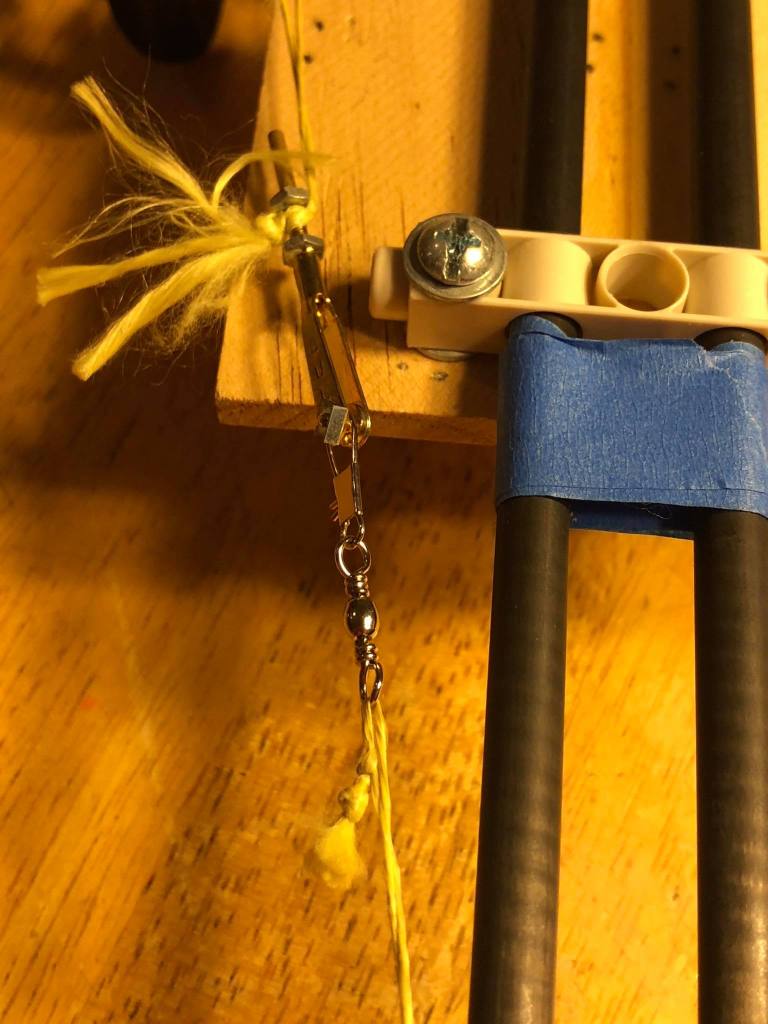
To accomplish the task of adjustable path curvature, I needed to make the front wheels of the vehicles rotatable. In addition, I attached two industrial grade chords to the ends of the front axel and looped the other end around a bolt towards the middle of the car. Along one chord, I inserted a spring and along the other, I inserted a length-adjusting screw. The matter of adjusting radius of curvature came down to toggling the length-adjusting screw. Interestingly enough, the changes in radius of curvature were so small between different final target points that I became lazy and just found a fixed radius that worked well for all points along the 9 m – 11 m range and rarely ever adjusted thereafter. Regardless, the adjustability factor still came in useful whenever I had to recalibrate the vehicle repeated use or sometimes even temperature and humidity differences!
Speed:
The sad reality of Science Olympiad is that it is extremely competitive. I already expected most of the top teams at any competition to be able to land the cup target point beautifully and come within 10 cm of the final target point. Therefore, speed would become a crucial tiebreaker. “Speed”, however, is a misleading term. 12 m is a long distance, but 12 m is also short enough that the car would still be in the acceleration phase for the greater length of the track. For the first 12 m cup push, I needed high but controlled acceleration. Eventually, the vehicle would have to slow down and reverse direction, so I could not have the car build up so much momentum that changing direction would cause the car to skid. After the direction change, there was no holding back. The car could accelerate at lightning pace towards that final target point and rely solely on the brakes to stop (skidding would be taken into account during calibration).

To accomplish my desired acceleration, I made it a priority to use very lightweight materials on my vehicle. The body of my vehicle, other than the mousetraps themselves which accounted for most of the weight, was made with parallel carbon fiber rods which I acquired by cutting an arrow in half. Many of the other parts were manufactured using 3-D printing, so they were made of PLA. For wheels, I ended up using the lightest wheels I could find that did not sacrifice traction. Wheels such as CDs have too high of rotational inertia and offer very little traction. I used foam wheels. Finally, all wheel axels were mounted to the car using ball-bearings which significantly reduced frictional energy loss. In order to make the initial acceleration towards the 12 m cup target point controlled, I reduced the girth of the axel where the string wrapped around. This gives me smaller torque, and thus smaller acceleration, but more distance per angular actuation displacement of mousetrap. On the way back, I made the back axel extra thick. The vehicle would drop the cup off and fly in the opposite direction, releasing most of the wound up string very quickly and achieving the vehicle’s top speed in the entire run. Any additional distance was easily covered as the vehicle glided along by its own momentum, seeing very little deceleration due to the ball bearings minimizing friction.
Results:
Ultimately, my vehicle did not disappoint. I could always count on it to hit the cup target perfectly and be within 5 cm of the final target point, all the while running on anywhere between 9-10.5 seconds. That’s 13 – 15 m with a direction change in between travelled in 9-10.5 seconds with nothing but the energy stored in two mousetraps. This is my proudest Science Olympiad engineering accomplishment. I had a perfect streak with this vehicle for my entire season until the National tournament, taking 1st at every invitational and official competition until I was pushed to 2nd by Solon High School of Ohio on the National stage. I would be disappointed, but the truth was I saw their vehicle. It was an amazing feat of engineering that deserved the win. Their car could achieve the same accuracy of mine while using only 6 – 7 seconds of runtime. I would try to explain what I could see, but I’ll leave it to them to ever disclose their genius. In the meantime, it will remain a mystery to you. Props to you Solon :).
 seanlin.dev