
Towers (or any of the Science Olympiad structure events), has a simple premise. The goal is to build a weight-bearing structure that meets minimum width/height dimensions that has the highest structural efficiency. This efficiency is defined as the mass held (g) / mass of the structure (g). As a simple example, if a tower holds 10 kg and weights 10 g, the efficiency of the tower is 10,000 / 10 = 1000.
For two years of high school, I poured my heart and soul into this event. It is perhaps the most tedious event in Science Olympiad when taken seriously, and I took this event very seriously. In fact my personal goal was to place in the top 3 at Nationals, the highest level of competition in Science Olympiad. I spent upwards of 10-15 hours a week building the tower to extreme precision, and each week I would test the tower to failure. Using slow motion cameras, I would identify the point of failure on my structure and reinforce that particular spot on next week’s design iteration. This cycle of building and breaking would repeat week after week until competition, where I would take my most successful design iteration, create an exact replica, and compete. It may seem unreasonable to spend 10-15 hours building a simple balsa wood structure that seems like it can be whipped up in less than an hour with sticks and super glue. However, I was striving for PERFECTION. Operating under the assumption that construction is flawless, the design is the differentiating factor. Choice of wood density and truss structure become the crux of the event. Unfortunately, when building these structure by hand, construction is NOT flawless. A perfect truss design can easily be ruined by poor craftsmanship and slightly bowed main beams. Therefore, the majority of my efforts during construction were focused on building pristine craftsmanship. Perfection requires time. As an example, I would spend 45 minutes simply choosing which sticks I wanted to use. I made sure the density was just right as well as evenly distributed before I was comfortable making my tower out of it. Fortunately, I will not bore you with the minute intricacies of my construction process or every single iteration of my design. Instead, I present my two most successful designs each year of competition.
2017:
The specifications of the event in 2017 were simple. The tower had to be a minimum of 60 cm tall, and the tower had to span a 15 cm * 15 cm square hole at the base. The top of the tower had to accommodate a 5 cm * 5 cm square block on top, from which weight would be added. The tower was allowed to hold up to 15 kg, but any more mass than 15 kg would not be considered. However, there is the possibility of a bonus. If the tower’s base instead could span a circle of diameter 25 cm, there would be a 5 kg bonus added to the final weight held.

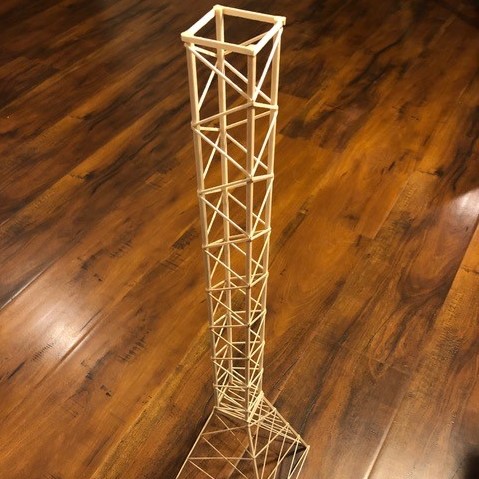
Pictured above was my final tower design that I took to the national competition. As you can see, I decided to go for the 5 kg bonus as the base of my tower is not a square and is intended to span a circle of 25 cm. In competition, it was common for teams to use 3 different base geometries. The first was the one that I used, a simple longitudinal rectangle that achieved the bonus. The second is a simple square base that barely spanned the 15 cm * 15 cm square hole from midpoint to midpoint. The third was a base similar to mine in that it was rectangular. However, this base only intended to span the 15 cm square, thus not achieving the bonus. The theory behind the bonus is simple: when the base that needs to be spanned is wider, the main beams of the tower need a more extreme taper towards the fixed dimensions of the top of the tower. The more extreme the taper, the less weight the tower will hold.
The final question I get about this design is: why this particular truss structure? It is common to gravitate towards an “X” truss or a “Z” truss in civil engineering. My answer is nothing glamorous and carefully calculated. I chose this truss structure because I saw it on a power tower once XD. I actually tried the “X”, “Z”, and power tower-inspired design and the last actually proved to use the least material! Yet, it proved enough for the purposes of competition. Why reinvent a structure that has been tried and tested by professionals?
| 2017 Tower | |
| Tower weight (g) | 6.28 |
| Tower load held (kg) | 12.8 + 5 (bonus) |
| Efficiency | 2,834 |
| Standing | 4th place Nationals |
2018:
The specifications of the event in 2018 in fact did not change from the previous year except for one key difference. The tower was no longer allowed to have a single continuous beam from head to toe. Instead, it had to have a discontinuity at at most 20 cm from the base. The top section of the tower now had to be straight and the bottom section needed to be tapered in order to meet the base dimension specifications.

As you can see, I had multiple final designs in 2018. My first design was clearly not as ambitious as the second, only aiming to meet basic specifications with no fancy truss structure. I chose to use evenly spaced “X” trusses for the bottom section and a simple zig-zag pattern of trusses for the top section. The trick with these towers was actually the precision. After a year of tower-building experience, I decided to create a jig that would help me maintain perfect beam straightness as I glued the trusses on the top section. The bottom section was created separately, and the trickiest aspect of this entire process was making sure the top and bottom sections aligned perfectly and level. Imperfect alignment meant that the beam cross sections at the discontinuity would not see complete coverage, causing potential for failure at the joint. Imperfect levelling would cause the straight section of the tower to rest at a tilt, causing for a disastrous failure due to imbalance. Regardless, once I got the craftsmanship down, this trivial design proved extremely effective.
The second design is visually more interesting and attempts to yet again achieve the 5 kg bonus by spanning additional distance at the base. The biggest issue here was that the taper of the bottom section was extreme, and much more of a handicap than for 2017’s tower. Ultimately, my truss design for the bottom tapered section drew inspiration from my 2017 tower design as well as tips from my physics teacher, not to mention trial and error. Traditional truss structures are great for preventing vertical or near-vertical beams from bowing in any direction, essentially acting as braces that keep the main load bearing beams straight. The taper of this tower is too far from vertical for the type of failure to be beam-bowing. Instead, the beams are much more likely to simply fail by shear stress. As such, the justification for my supports that hug close to the tapered beams is rather to reinforce the shear strength of the beams rather than prevent them from bowing.
I ended up using my first design at the national competition, which was a mistake in retrospect. This design gave me my highest efficiency score throughout the season, and I was hoping it would repeat its earlier success. However, the issue with the first design is that it is too reliant on certain factors that I cannot control. Without the grace of a bonus, this design’s merit was justified almost solely by its light weight. Due to this, I was forced to use very light and unevenly dense sticks, making room for unexpected and uncontrollable points of low-density. The second design, though it did not have as high of a peak efficiency, was more stable. The certainty of 5 kg of added bonus as well as the necessity to use heavier sticks, which are more reliable and homogenous in density.
| 2018 Tower 1 | 2018 Tower 2 | |
| Tower weight (g) | 4.90 | 6.80 |
| Tower load held (kg) | 15 | 13.9 |
| Efficiency | 3061 | 2779 |
| Standing | 1st place MIT | 1st place State |
Reflection:
Tower building was unquestionably the Science Olympiad event I was most dedicated to. In a way, I regret spending so much time trying to perfect a design as I chased a superficial medal. The desire of being presented the award on-stage was motivated by vanity. Aside from the initial ideation of the design and truss structure I would use, I did not learn anything from the repetitiveness. I sometimes wonder at the opportunity cost of my unhealthy dedication. I was sacrificing quality time with friends and family in order to perfect my craftsmanship. Regardless, I can proudly say that I do not regret the experience as a whole. The spirit of Engineering is all about patience and resilience towards failure. Perfection is not achieved overnight, and the years I spent building structures for Science Olympiad have driven that home hard.
 seanlin.dev