
Visualization For Design
Engineering 25 is a general engineering course and one of the first engineering classes for many students at Berkeley. The course is split into two distinct halves: a learning half and an application half.
The first half of the course focuses entirely on 2-D sketching and component visualization. Admittedly, this half was quite fun, and I was quite good at it. I have always been a strong spatial thinker, often approaching difficult problems by trying to visualize a physical model in my head. Typical homework sets through the first half of this course included redrawing a given object in isometric view after a series of rotations, or visualizing how a certain object would look along a certain x, y, or z axis given the viewpoints from the other two axes. I loved problems like these. They are not tedious in the sense that I would have to grind through a lot of intermediate and trivial work to arrive at an answer. Instead, the entire problem-solving process was reliant upon the capabilities of my parietal lobe, and thus was never boring. Of course, having to physically draw the rotated object or new perspective could be considered time-consuming “busy work”, but come on, who doesn’t like to doodle for points?

Although the subject did not change during the latter half of the course, the learning emphasis differed quite a bit. The second half of the class was dedicated to learning the minutiae of engineering drawings, including standard drawing symbols and protocols. Additionally, we had to learn the horrendously unintuitive software which is AutoCAD. Though some may consider AutoCAD the “Holy Grail” of all CAD software, I beg to differ. The learning process was extremely tedious for me as I did not understand the reasoning behind many of its functionalities. Perhaps as I mature in my engineering abilities, I will come around to AutoCAD with a newfound appreciation. If this is the case, I will append an edit to this post with my sincerest apologies to AutoCAD.
The final project in this class was a truly hefty task. It was at this point when a 2-unit class morphed into a 20-unit, 9-5 job for me. I was already having difficulty learning AutoCAD and getting accustomed to its odd functionality, so creating an entire product with many individual components and parts proved to be a time-consuming nightmare. Needless to say, I enjoyed this project, and the latter half of the class in general, much less than the first.
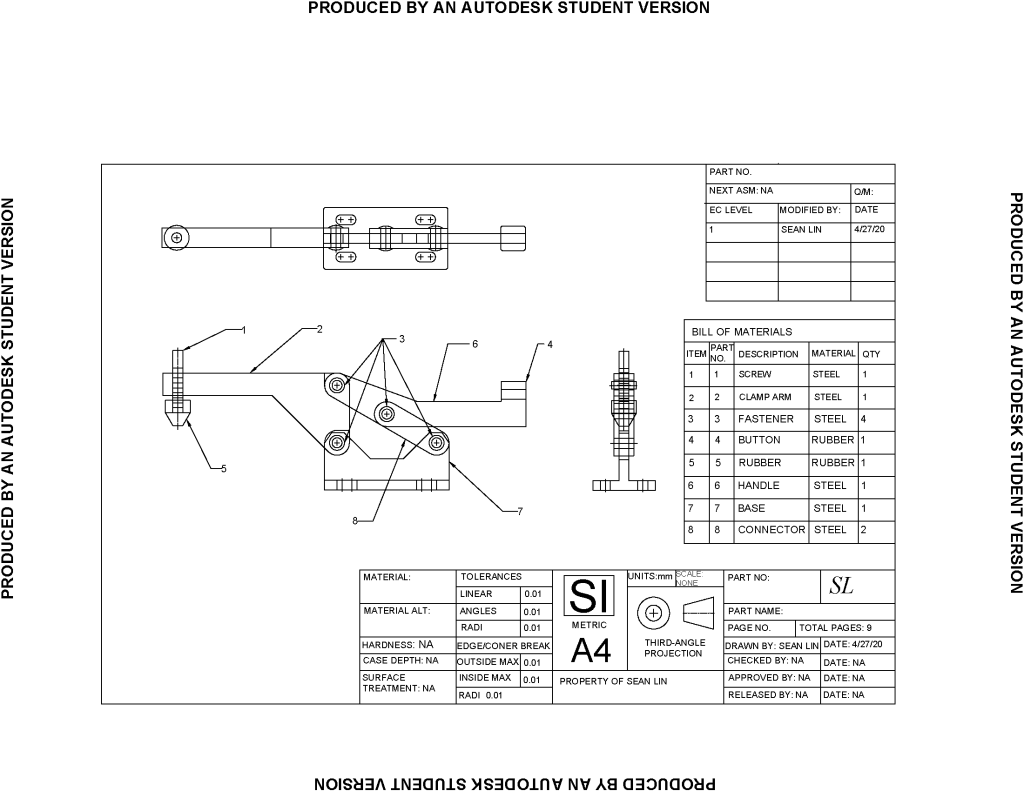
Ironically, it was the latter half of the class which I took the most away from. Though the first half of the class was fun and mildly challenging, I was beating around the bush “learning” things that I already knew. However, frustrating the second half of the class may have been, I can confidently say I learned a lot. From the formal rules of engineering drawings to the basics of AutoCAD, I was able to almost immediately apply these new skills to my future summer internship as well as personal projects.
Food For Thought
Which of the following components matches the front and top views given?

 seanlin.dev